
Strategic Management Newsletter Registration

Sales Passion
Passion that Delivers Excellence
The article outlines the four key principles that Chad Goldwasser, the former #1 real estate agent for Keller Williams, attributes to his success in business and life. He emphasizes that achieving legendary status in any field requires a combination of high energy, positivity, genuine care for others, and relentless mastery of one’s craft. These principles are not about complex strategies but about embodying passion, uplifting others, and striving for excellence every day.
Four Key Points:
Live with Passion and Energy: Exude infectious enthusiasm and high energy to stand out and attract people to your business.
Spread Positivity and Joy: Create a memorable, uplifting experience for others, as people remember how you make them feel more than specific details.
Love and Believe in People: Build trust and loyalty by genuinely believing in your clients’ potential and supporting their dreams.
Master Your Craft: Commit to excellence by deeply studying and refining your skills to become the undisputed expert in your field.
Solution Selling – A Different Selling Perspective
By: Gary D. Seale – Principal – The Trucon Consulting Group, LLC
Many traditional sales instructions advocate a probing question process to identify the prospect’s real needs. Once those needs are identified, then the salesperson is tasked to present the product to the prospect so they will decide to purchase.
This process makes a major assumption. It assumes that the prospect has enough trust and interest to answer all those questions. This can be an issue due to the reticence of new prospects answering questions from a relative stranger. If you are in the early stages of developing awareness and interest in your product, then the deep question mode has inherent difficulties.
A solution selling perspective must rely on the marketing activities of the company to uncover viable prospects and quality them regarding the authority to make a purchasing decision. By necessity, if you have a small firm, then many of the marketing responsibilities will fall back on the owner or salesperson. Never-the-less it will always remain imperative to focus on your target market audience and qualify them before there is too much sunk cost in a non-viable potential customer.
The changes in the marketplace driven by the information available on the internet and the willingness of your prospect to do a deep level of research have made a solution selling strategy viable and necessary in many cases.
Your prospects are looking for real solutions that solve problems. That is why I have stressed the importance of the salesperson becoming a subject matter expert in the past.
In this case, it not simply just the salesperson, but the entire company that must be willing to offer a package of customized, bundled products and services to solve issues and earn business.
One of the distinct keys to having success with this approach is retaining salespeople who are schooled and experienced enough in the target market industry to be able to interact as a true resource to their prospects.
They should be able to put a unique proposal together that gives the prospect a new way to manage or approach their business. As a salesperson, they should be so knowledgeable about the prospect’s business that it serves as a foundation that allows them to make firm recommendations to the prospect’s staff and methods of doing business.
The salesperson should know what the real market drivers are for that industry. For example, in the crude oil marketplace in the domestic United States, $60 a barrel represents a benchmark of profitability that will allow a drilling company and producer to pay for the drilling, production and transportation costs and still make a viable profit. In contrast, crude oil produced in Saudi Arabia requires a higher cost per barrel price due to the commitment to the extensive royal family to provide living subsidies. This market data is available on a daily basis. An awareness of these market drivers and the influence they make will allow the salesperson to make better decisions and have a more superior interaction with a client.
The Solution Selling method may entail having the salesperson teach the prospect’s staff and production people about how their product will make them more competitive in the marketplace. Which is essentially another aspect of making the salesperson a subject matter expert.
As an engaged sales agent in the process, this strategy will challenge you to provide alternatives and act as an ongoing consultant. Make sure that as the representative for the supplier company you are in communication with every department in the company where your solution will have an impact.
All of these strong capabilities will allow you to challenge the prospect to make a purchasing and implementation decision.
The author has seen this method work very well in the semiconductor production tool and wafer manufacturing business. The strongest supplier in the static control and static induced contamination control market dominated the minds and purchasing decisions of the major players in the semi market due to PhD level research, publications, association participation and highly knowledgeable system of direct representatives and well-respected rep firms. They challenged the semiconductor contamination staff at the manufacturers with research from their own labs that exceeded the research at the manufacturer’s people. And they dominated the market!
These brief comments provide an outline of the thought processes necessary to stepping in with a business solution proposal. To implement these changes may require some deep training or attracting people from your target market that can provide you with the expertise necessary to deliver real solution selling alternatives. Be careful that you don’t allow this perspective to be ignored. It could be a vein of pure gold for your company.
The Sales Funnel
Trucon Business Development makes literally thousands of cold calls and follow up efforts every month to introduce our customer’s products and services. When introductory calls are made with little or no brand identification, the actual sales results tend to be low. This should be no surprise in a startup situation or with a product launch. Positive responses run from 1% to 3%. That’s why factoring in a time consideration based on repeated contacts with your prospects and a return on investment calculation is very important.
According to author Chet Holmes in the book titled The Ultimate Sales Machine, only 3% of your prospective demographic are in the market to buy “right now.” And only 6-7% of your prospects are open to a purchase in foreseeable future. That means that 90% of your prospects are not in the market for your product.
Additional experience from Trucon reveals that the immediate buying interest for a new, unknown product varies significantly depending on the competition, season of the year, lack of a trust factor, perceived need, budget restrictions, possible lack of a viable return on investment and the time available to institute a change in the client’s business model or culture. They may be higher or lower than Holmes’ stated value of 3%.
To reflect an accurate picture of a proactive sales program, the following factors must be taken into consideration.
Target Demographic
One of the primary considerations is the necessity of targeting the right demographic profile for your product. Targeting the wrong industry, company size or even an incorrect staff member can cost you valuable time, expenses and lost revenue. An accurate market perception can take weeks or months to determine depending on the number of contacts attempted, actual decision makers contacted, questions that the sales staff asks and the responses obtained.
One common tool available to every sales organization is a database mining service such as Sales Genie or Dun and Bradstreet. The sales team can set parameters from SIC codes, industry categories, the gross sales, number of employees, geographic proximity and even decision maker titles. These services will break down the broad categories into specific descriptions which allow for more accurate prospecting efforts. These types of tools spare the team significant amounts of prospecting time when launching a new company or product.
The Sculpted Message
Trucon’s experience over the past five years reveals that a call recipient will allow a cold caller to have 60 to 75 seconds on the phone with them before they start closing their already limited level of receptiveness. The template that the company has found most useful is as follows:
- Ask for individual by name if at all possible
- Once connected, identification with full name and company affiliation is stated
- Ask permission to proceed, call back later or send an e-mail (This lowers the push back level)
- Permission granted, inform them of call brevity. Provide two benefit statements and ask permission to send an e-mail with more detail.
- Capture their e-mail, inform them they will receive the information right away and tell them you will be calling back next week (3-5 working days) to get their impression.
- Voice mails can be crafted in much the same manner
- The chase begins!
Actual Call Results – Via Telephone Introduction
A response from an effort of 200 outbound calls with a business to business product in four weeks is reflected in the following chart.
| Week | Calls | Follow Up | Admin Contact | Decision Maker Contact | Voice Mails Left | Interested in Product | Not Interested |
| 1 | 50 | 0 | 25 | 8 | 12 | 2 | 3 |
| 2 | 50 | 10 | 20 | 6 | 10 | 1 | 3 |
| 3 | 50 | 7 | 10 | 10 | 18 | 3 | 2 |
| 4 | 50 | 10 | 18 | 5 | 13 | 0 | 4 |
| Total | 200 | 27 | 73 | 29 | 53 | 6 | 12 |
| % 100% 13.5% 36.5% 14.5% 26.5% 3% 6% | |||||||
*Results from Trucon Business Development Contract, September 2015
Statistically speaking, a company will need at least 30 qualified responses before they can consider the sampling of calls to be valid. Consequently, it could easily take 500 to 800 calls before the sample could be deemed totally reliable. Even with a minimum quantity of reliable responses, this conclusion must be tempered by a number of factors, including seasonal purchasing factors, budget year considerations, prevailing economic conditions, brand recognition and quality of the individual salesperson.
In addition, it must be noted that it will take multiple calls into the same prospect to re-contact admin people, door keepers and decision makers before a reliable response can be tallied. Six to ten contact efforts per decision maker is not uncommon.
Nurturing and Call Repetition
According to a recent Linkedin report called Full Funnel Marketing, 60 to 70% of the decision making regarding a new purchase has been done before there is any interaction with a sales professional. In a B to B purchasing decision, 90% of the research has already taken place according to Forrester Research. One key element reported in the Linkedin report is the longer close cycles that are now being experienced in business as a whole. Consequently it is necessary for the supplier to be fully engaged with a Soft Nurturing approach to ensure that its target demographic has full access to all the information necessary to educate the individuals responsible for making a buying decision.
The Linkedin Full Funnel Report segregates the marketing effort into two segments:
Upper Funnel:
- Display advertising
- Public relations
- Social media engagement
- Blog content generation
Lower Funnel:
- Gated content offers
- Webinars
- Social media advertising
- Search marketing
- Email marketing
These efforts are meant to drive brand recognition into the respective target market. However vigilant a supplier may be with their marketing effort, all too often budget restrictions and the massive amount of marketing messages and content in the marketplace can mask the desired recognition.
However there are ways to engage with specific prospects that still incorporate aspects of both the Upper and Lower Funnel approach. John Maxwell Team Consultant Danny L. Smith in Austin, TX has devised an eight step plan which includes Linkedin connections, posting, e-mails, sharing content, phone calls and research on the prospect over a four week time period or longer. Smith’s approach may be implemented on a scale with individual sales people to avoid the impression that all the provider wants is a quick close and be done with you philosophy.
Lower Funnel Details
A foundational aspect of the marketing approach must be a website which has a graphics attraction component in conjunction with the educational information that clearly informs the prospect what benefits will be obtained by engaging with the provider. The SEO component cannot be neglected and should be addressed on a regular basis.
The high touch customer engagement aspect of the lower funnel will involve lead follow up with phone calls and e-mails. These follow up activities should be conducted with a well-crafted call script (not to be read to the prospect!) and e-mail messages. Newsletters, following up with opens and click troughs, plus documentation in a customer resource management software tool should be implemented as well. Posting into your social media sites and groups is an inexpensive and important method of staying visible to prospects and referral partners as well.
Day to day lead generation may be done with traditional prospecting methods or a Linkedin process where client profiles lead to connection requests and eventual engagement. Personal calls and networking still have the best rates of return. However they tend to be expensive and are not scalable on a rapid basis, unless you have deep pockets or start-up funding that will support that effort.
This is the point where the spaced repetition contact process constructed by Smith will come into play. Of course the efforts will not be complete without actually closing business. Know your close ratio. Literally count the number of actual presentations to a prospect versus your closed business number and determine that percentage. Once you have made 30 to 50 presentations you can begin to rely on that close rate. This is not to say that you should not seek to improve the target market identification or the quality of the presentation, continuous improvement should always be a goal.
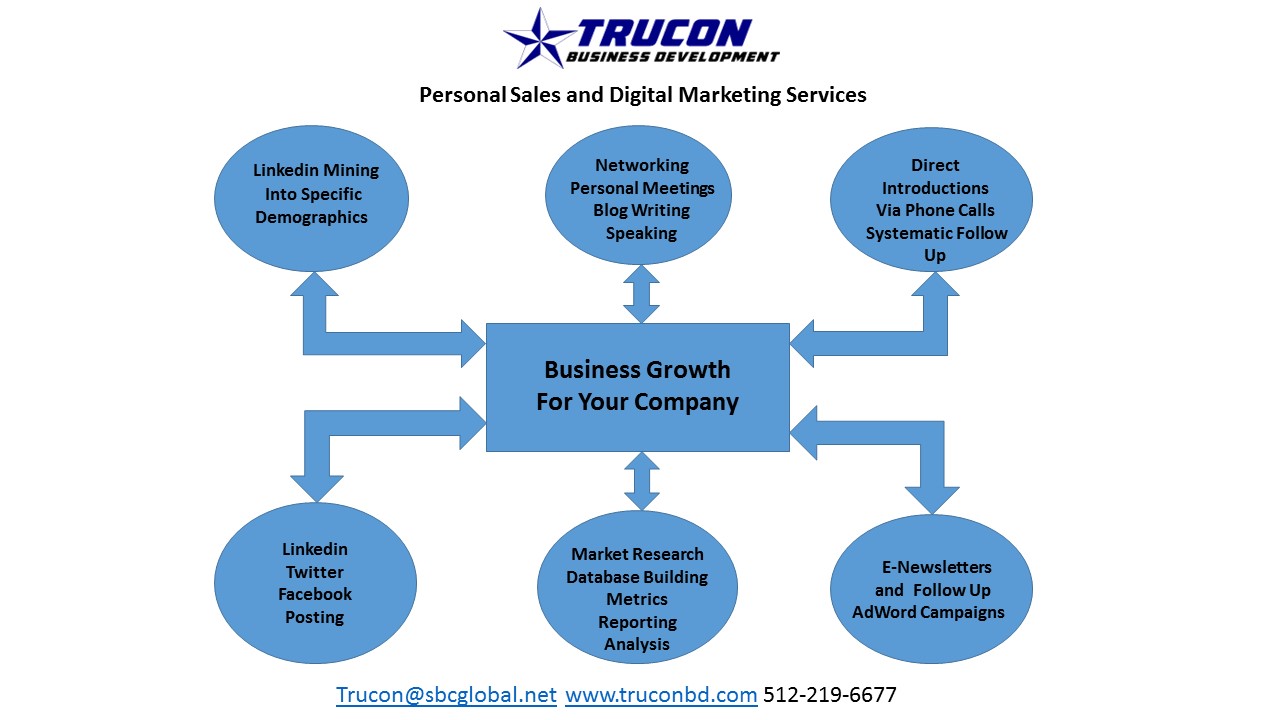
The graphic representation below provides some additional details about the activities that may be considered Lower Funnel necessities.
Competitiveness
It is understood that in the consumer products arena that it is possible to position a product according to quality and pricing and still be competitive. In the B to B marketplace, positioning is still possible, but somewhat more difficult. Industrial products can certainly have features that can be added or deleted, but that component is not readily available on many mass produced products.
Consequently the competitiveness of the product or service can break a company over time or relegate it to a very narrow slice or the market without hope of growth.
Summary
The process of crafting a competitive message and relaying it to the proper market is a challenging and time consuming task. First time sales people and business owners must temper their expectations and understand that success becomes as a result of a volume of calls into the proper market with an engaging message and the persistence necessary to actually get in touch with a decision maker.
And of course, the proprietors must work with as many aspects of the upper funnel that can be used to make them visible, but yet affordable. All of these characteristics should be considered part of the art and science of sales.
10 Best Sales Questions to Use When Talking with a Customer
One of the best things any salesperson can do is develop a list of 10 questions they feel comfortable asking.
The questions have to fit your personality and your market and allow you to move the process forward.
Below are what I’ve found are the 10 best sales questions you can use. The questions are not direct closing questions, but rather questions that will get the customer to share more information to help you focus on the solution the customer desires.
Not each question will be appropriate for every occasion. The critical issue is to be comfortable asking them so when the situation is right, you’re also ready:
- Why?
- Can you tell me more?
- How have you made decisions like this in the past?
- What is the outcome you’re looking for?
- What is the size of the risk if you don’t make a decision?
- What are the issues you’re facing today?
- What happens if you don’t make a decision to buy?
- Who else is involved in the decision making process?
- What is it you like best about what we’ve been talking about?
- What is stopping you from making a decision?
Each of the questions is designed to get the customer to share more and to allow you to then ask a follow up question on what they just shared with you. Questions one and two are specifically designed to do just that.
100 Guerilla Marketing Weapons
- Marketing plan
- Marketing calendar
- Niche/positioning
- Name of company
- Identity
- Logo
- Theme
- Stationery
- Business card
- Signs inside
- Signs outside
- Hours of operation
- Days of operation
- Window display
- Flexibility
- Word-of-mouth
- Community involvement
- Barter
- Club/Association memberships
- Partial payment plans
- Cause-related marketing
- Telephone demeanor
- Toll free phone number
- Free consultations
- Free demonstrations. Free seminars and clinics
- Free samples
- Giver vs taker stance
- Fusion marketing
- Marketing on telephone hold
- Success stories
- Employee attire
- Service
- Follow-up
- Yourself and your employees
- Gifts and ad specialties
- Catalog
- E-Yellow Pages ads
- Column in a publication
- Article in a publication – Blogging
- Speaker at any club
- Newsletter
- All your audiences
- Benefits list
- Computer
- Selection
- Contact time with customer
- How you say hello/goodbye
- Public relations
- Media contacts
- Referral program
- Sharing with peers
- Guarantee
- Telemarketing
- Gift certificates
- Brochures
- Electronic brochures
- Location
- Advertising
- Sales training
- Networking
- Quality
- Reprints and blow-ups
- Flipcharts
- Opportunities to upgrade
- Contests/sweepstakes
- Online marketing
- Classified advertising
- Newspaper ads
- Magazine ads
- Radio spots
- TV spots
- Infomercials
- Movie ads
- Direct mail letters
- Direct mail postcards
- Pdf decks
- Posters
- Fax-on-demand
- Special events
82.Show display
- Audio-visual aids
- Spare time
- Prospect mailing lists
- Research studies
- Competitive advantages
- Marketing insight
- Speed
- Testimonials
- Reputation
- Enthusiasm & passion
- Credibility
- Spying on yourself and others
- Being easy to do business with
- Brand name awareness
- Designated guerrilla
- Customer mailing list
- Competitiveness
- Satisfied customers
Discover Your Target Market in Five Questions
Why is it so important to identify a specific target market? Why would you need to spend the time and energy to narrow your focus and distinguish that best person to buy from you?
Because when you are clear about your ideal customer and you can articulate it to the market place, it will light up the referral magnet and attract buyers beyond your wildest dreams! Ideal, money-paying customers will seek you out as the company who can solve their problems!
FIVE SIMPLE QUESTIONS
- What are your products and services…specifically?
What do you sell? Break it down into a list of specific products and services. It’s time to “unbundle” your offerings. Here is where you want to create the “laundry list” of all the specific things you have expertise in providing. Peel back the onion and break it into pieces.
A Realtor doesn’t simply sell houses. They have Condos, Ranch Houses, Luxury Homes, Up-Grades, Custom Homes, Two Story Houses, Starter Homes, Duplexes, Investment Properties, Ranch Homes, Homes on Acreage, Rural Homes, Down-town Apartments etc. They have an 8 Point Listing System that includes staging, repairs, curb appeal, video tours, marketing, competitive bidding etc.
Business Attorney offers Buy-Sell Agreements, Purchasing Contracts, Selling Contracts, Document Revision, Non-Disclosure Agreements, Non-Compete Agreements, Litigation, Collections, Partnerships, LLC, Exit Strategies and other legal protections or services.
The point is… make a list of 20 “unbundled” specific products and services your company provides.
- What specific problems do those products solve?
This is HUGE in turning on the referral magnet and getting the attention of your target market! After you have listed your products and services, now determine the specific pain or problem that product addresses. It usually will fall into categories of mental or physical. In other words it removes an anxiety or it fixes a broken, concrete problem like moving into a house.
This is the “nerve” you are looking for. This is WHY you are in business. You solve a problem. What is the problem you solve.. specifically?
- Who most needs those products or services?
Once you get more well-defined about the problem you solve, your target market will become clearer. The Business Attorney is passionate about Partnership Agreements. He recognized that a couple of good buddies going into business together has potential for great success and financial wealth. But it is more likely to dissolve a good friendship over misunderstanding about the division of responsibility and assets. He said, she said has turned more than one great friendship into a nightmare of distrust.
So based on that, who is the Business Attorneys target market; Buddies or Friends starting a business project together.
- Where do they live or cluster?
People cluster. Demographics tend to pull people of similar likes into groups and associations. Those can be professional or personal. Neighborhood or business corridors. Social groups or professional associations. The point is when you identify your most likely client, now you can start looking at where he or she hangs out. And now you know WHERE to market or network.
- Which combination makes you the most revenue?
This is a numbers game. Get out your sales receipts, a calculator and your product list. Which products bring in the most revenue…per time spent? What offering do you have that make the most money? Where is your margin the highest?
James owns an HVAC company. For a long time, new construction was his target market. The demand was high and it was easy. New houses needed HVAC and it was a simple install. But the margin was low… real low. James started looking at another product he offered: HVAC Maintenance for homeowners with units 3 years or older. The margin was much higher! The revenue was much higher. In his first year, he added $100K to his bottom line and worked less!
Now he knows…..
- WHAT specific products and services to market
- WHICH specific problems he addresses
- WHO is going to engage him
- WHERE his best clients live
- HOW much he is going to make.
Knowing your target market can have a huge impact on your business!
How would you like to meet bi-weekly with a group of small business owners who are covering topics like this AND becoming Certified Referral Networkers? Contact me for more information and local classes.
Scott Carley – Consultant
Sales Fundamentals
Pre-Plan and Execute
As much as we like having the latitude of being a salesperson, the reality of our situation can be compared to being a good soldier in the Army. Think of yourself as being a trusted officer that has been tasked with a mission. You apply your previous training and experience to the assigned task. You know there are no real shortcuts. And you must consistently apply the fundamentals to every aspect of your job.
As a combination C/D personality, planning and execution come somewhat naturally. But, I can get lazy at times and start hoping for that unexpected close that happens to us occasionally. The key words in that last sentence stand out in a glaring fashion as strategies to failure. Hoping, unexpected and occasionally are not the pathway to success!
My most satisfying days are when I plan well, execute that plan and see results from my activities. Phone calls placed, forms completed, marketing pieces generated, presentations made, meetings completed, quotes out the door, business closed and preparation for the upcoming days and weeks ahead all combine to secure sales. So put on your mental uniform and see that your mission is accomplished each and every day.
The Sales Funnel Principle
The cliché that knowledge is power certainly applies today just as it did back in the 70′s when I first got into sales. The concept that prospecting is a process of trial and elimination by both you and the potential customer is an extremely important piece of knowledge. And, of course it is important to define a target market. This will constrain your prospecting efforts to accounts with a higher probability for success. The concept can be visualized as a funnel where at the top all of your prospects are placed. The small end of the funnel represents all the business you close.
To aid you with the requirement for prospecting, start keeping track of all the reasons companies decline to do business with you. Here are a few categories that I’m sure you have encountered previously:
- No money in the budget for your product / Budget constraints
- Existing trust relationship or contract with a competitor
- Corporate makes these types of decisions
- No perceived need
- We’re moving out of town
- We’re going out of business
- No trust relationship established
- The product is too expensive
- We only have seasonal requirements
- Your product is not qualified or does not have the correct agency approvals
This knowledge also helps with your motivation to keep prospecting. Walk a mile in your prospect’s shoes and don’t take it personally when you hear a “no.” Determine the number of contacts and the repetition it takes to find a qualified customer. Then use very tool at your disposal to produce the gold that flows out of your sales funnel!
 The TRUCON Consulting Group, LLC